
Introduction: How Many Weeks Are in a Year
Time is one of the most important aspects of our daily lives, yet many people still have confusion about basic time calculations. One of the most commonly asked questions is: how many weeks are in a year? At first glance, the answer seems simple—52 weeks—but when you look deeper, the explanation becomes much more interesting and detailed.
Understanding how weeks fit into a year is not just a matter of curiosity. It plays a crucial role in planning schedules, managing work timelines, organizing academic calendars, and even creating SEO content strategies. From students to professionals and bloggers, everyone benefits from knowing how time is structured.
In this comprehensive guide, we will explore everything you need to know about weeks in a year. We will cover basic calculations, leap years, calendar systems, working weeks, and even some fascinating facts about how time is measured. By the end of this article, you will have a complete and clear understanding of this topic.
What Is a Week?
Before understanding how many weeks are in a year, it is important to understand what a week actually represents.
A week is a unit of time consisting of 7 days:
- Monday
- Tuesday
- Wednesday
- Thursday
- Friday
- Saturday
- Sunday
This 7-day system is globally accepted and is part of the modern calendar system used worldwide.
Quick Answer: How Many Weeks Are in a Year?
Let’s start with the simplest and most direct answer:
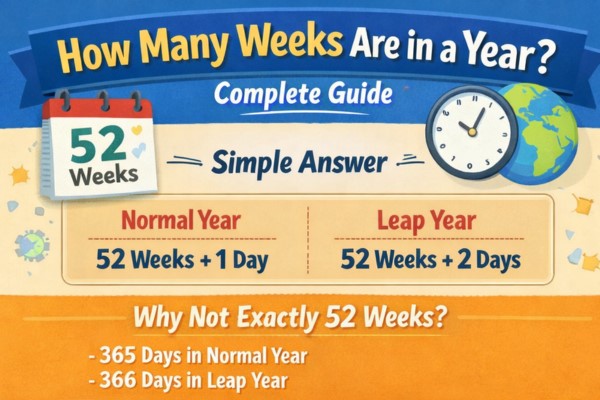
- A normal year has 52 weeks + 1 day
- A leap year has 52 weeks + 2 days
Mathematically:
- 365 ÷ 7 = 52.14 weeks
- 366 ÷ 7 = 52.28 weeks
This means that a year contains 52 full weeks, but there are always extra days left over.
Understanding the Basic Calculation
To fully understand the concept, let’s break it down step by step.
Total Days in a Year
- Normal year = 365 days
- Leap year = 366 days
Days in a Week
- 1 week = 7 days
Calculation
For a normal year:
- 365 ÷ 7 = 52 weeks + 1 day
For a leap year:
- 366 ÷ 7 = 52 weeks + 2 days
This simple calculation explains why a year does not have exactly 52 weeks.
Why a Year Is Not Exactly 52 Weeks
Many people assume that a year consists of exactly 52 weeks, but this is not entirely accurate.
- 52 weeks = 364 days
- Actual year = 365 or 366 days
This creates a difference of:
- 1 extra day in a normal year
- 2 extra days in a leap year
These extra days are responsible for the shifting of calendars each year. Because of this, the same date does not fall on the same weekday every year.
What Is a Leap Year?
A leap year is a special year that contains 366 days instead of 365.
Why Do We Have Leap Years?
The Earth takes approximately 365.24 days to complete one orbit around the Sun. Since our calendar uses whole numbers (365 days), there is a small difference each year.
To correct this difference, an extra day is added every four years.
Leap Year Rules
A year is a leap year if:
- It is divisible by 4
- But not divisible by 100
- Unless it is also divisible by 400
This system helps keep our calendar aligned with Earth’s orbit and seasons.
Weeks in a Leap Year vs Normal Year
| Year Type | Total Days | Weeks | Extra Days |
|---|---|---|---|
| Normal Year | 365 | 52 | 1 day |
| Leap Year | 366 | 52 | 2 days |
Even in leap years, the number of full weeks remains 52.
Weeks vs Months: Understanding the Difference
Many people confuse weeks with months, but they are different units of time.
Key Differences
- 1 week = 7 days
- 1 month = 28 to 31 days
On average:
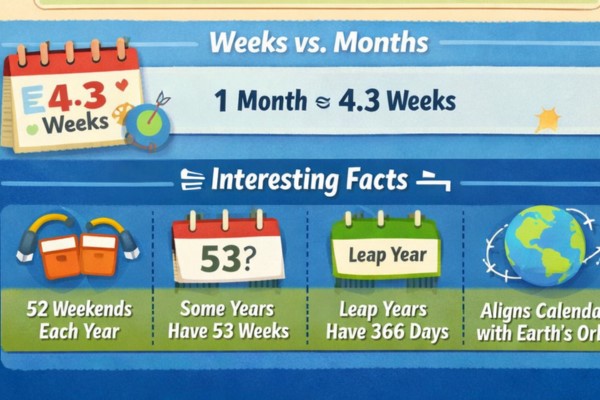
1 month ≈ 4.3 weeks
Monthly Breakdown
| Month | Days | Weeks (Approx) |
|---|---|---|
| January | 31 | 4.4 weeks |
| February | 28/29 | 4 weeks |
| March | 31 | 4.4 weeks |
| April | 30 | 4.3 weeks |
| May | 31 | 4.4 weeks |
| June | 30 | 4.3 weeks |
| July | 31 | 4.4 weeks |
| August | 31 | 4.4 weeks |
| September | 30 | 4.3 weeks |
| October | 31 | 4.4 weeks |
| November | 30 | 4.3 weeks |
| December | 31 | 4.4 weeks |
Calendar Breakdown of a Year
Let’s visualize how weeks fit into a full year:
- Total days = 365
- Total weeks = 52
- Remaining days = 1
That extra day causes the calendar to shift every year.
Example
If a year starts on Monday:
- Next year may start on Tuesday
- After a leap year, it may shift by 2 days
This is why your birthday does not fall on the same weekday every year.
What Is a 53-Week Year?
Sometimes, you may hear about a 53-week year.
When Does It Happen?
A year can have 53 calendar weeks when:
- The year starts on a Thursday
- Or in certain leap year situations
This is based on week-numbering systems where weeks are counted differently.
However, this does not mean the year has more days. It is simply a different way of organizing weeks.
Working Weeks in a Year
In practical life, people often calculate working weeks instead of total weeks.
Standard Calculation
- Total weeks = 52
- Weekends = 104 days
So, working days are approximately:
- 261–262 working days per year
This is commonly used in:
- Salary calculations
- Business planning
- Project timelines
Importance of Understanding Weeks in a Year
Knowing how many weeks are in a year is useful in many real-life situations:
Academic Planning
Schools and colleges often structure terms based on weeks.
Business and Finance
Companies use weekly reporting systems and 52-week financial calendars.
Fitness and Goals
People set weekly targets for exercise, diet, or productivity.
Content Planning (SEO)
Bloggers and marketers plan content calendars based on weeks.
Interesting Facts About Weeks and Years
Here are some fascinating facts:
- A year is not perfectly divisible by 7
- There are always 52 weekends in a year
- Leap years keep our calendar aligned with Earth’s orbit
- Some years have 53 numbered weeks
- Calendar systems are designed to balance astronomical and practical timekeeping
How to Calculate Weeks in Any Year
You can calculate weeks easily using this formula:
Number of days ÷ 7
Example:
- 365 ÷ 7 = 52 weeks + 1 day
- 366 ÷ 7 = 52 weeks + 2 days
Common Misconceptions
Myth 1: A Year Has Exactly 52 Weeks
Reality: It has 52 weeks plus extra days.
Myth 2: Every Month Has 4 Weeks
Reality: Months have 4 to 4.4 weeks.
Myth 3: Leap Year Changes Weeks Count
Reality: It only adds extra days, not full weeks.
FAQs (Frequently Asked Questions)
1. Are there exactly 52 weeks in a year?
No, there are 52 full weeks plus 1 extra day (or 2 in a leap year).
2. How many weeks are in 365 days?
365 days = 52 weeks + 1 day.
3. How many weeks are in 12 months?
Approximately 52 weeks.
4. Can a year have 53 weeks?
Yes, depending on how days fall in the calendar.
5. Why do weeks not divide evenly into a year?
Because 365 and 366 are not divisible by 7.
Conclusion
So, how many weeks are in a year?
The simple answer is 52 weeks, but the complete explanation reveals more detail.
A normal year has 52 weeks and 1 extra day, while a leap year has 52 weeks and 2 extra days. These extra days exist because the Earth’s orbit does not perfectly match our 7-day week system.
Understanding this concept helps in better planning, scheduling, and managing time effectively in daily life, academics, and business.