


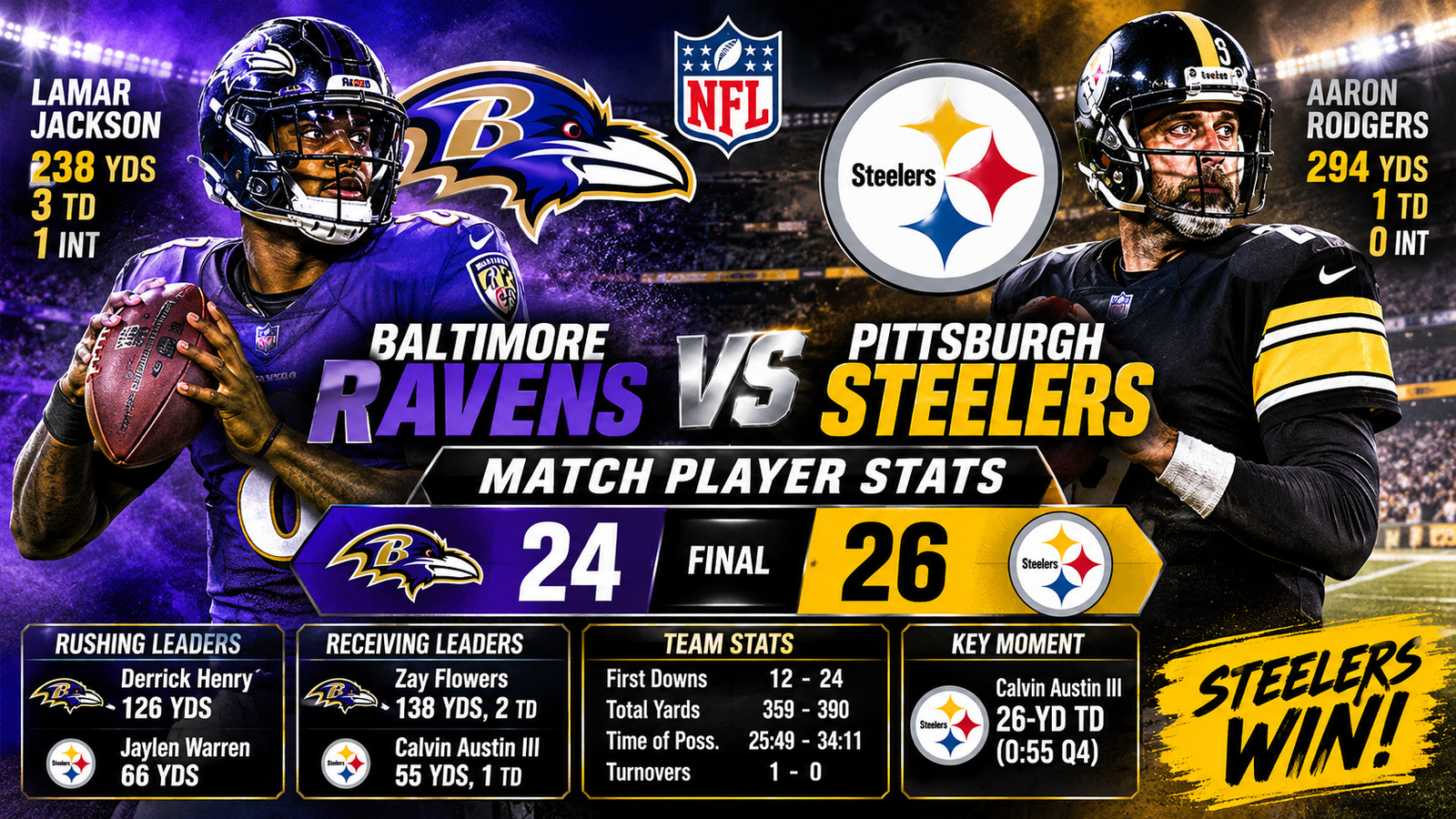
The Baltimore Ravens vs Pittsburgh Steelers matchup on January 4, 2026, delivered one of the most dramatic finishes of the NFL regular season. Played at Acrisure Stadium in Pittsburgh, the Week 18 contest featured outstanding quarterback performances, explosive receiving plays, powerful rushing attacks and a decisive touchdown in the final minute.
The Pittsburgh Steelers defeated the Baltimore Ravens 26–24 in a closely contested game. Lamar Jackson produced three passing touchdowns for Baltimore, while Zay Flowers delivered an outstanding receiving performance with 138 yards and two touchdowns. On the other side, Aaron Rodgers threw for 294 yards and helped Pittsburgh complete a late comeback.
This article provides complete Baltimore Ravens vs Steelers match player stats, including quarterback performances, rushing and receiving numbers, defensive contributions, scoring details, team statistics and an advanced match timeline.
Table of Contents
Baltimore Ravens vs Steelers Match Overview
The final regular-season meeting between Baltimore and Pittsburgh took place on January 4, 2026. Both teams entered the contest with significant postseason implications, making the divisional rivalry even more important.
Pittsburgh used its home-field advantage and controlled the ball for longer periods. Baltimore created explosive offensive opportunities, particularly through Lamar Jackson and Zay Flowers, but Pittsburgh’s late offensive execution made the difference.
Match Information
| Match Detail | Information |
|---|---|
| Match | Baltimore Ravens vs Pittsburgh Steelers |
| Competition | NFL 2025 Regular Season |
| Week | Week 18 |
| Date | January 4, 2026 |
| Venue | Acrisure Stadium |
| Location | Pittsburgh, Pennsylvania |
| Baltimore Ravens Score | 24 |
| Pittsburgh Steelers Score | 26 |
| Winning Team | Pittsburgh Steelers |
| Losing Team | Baltimore Ravens |
| Game Duration | 3 hours 12 minutes |
| Attendance | 65,400 |
| Final Result | Steelers won by 2 points |
Quarter-Wise Scorecard
| Quarter | Baltimore Ravens | Pittsburgh Steelers |
|---|---|---|
| First Quarter | 7 | 0 |
| Second Quarter | 3 | 3 |
| Third Quarter | 0 | 10 |
| Fourth Quarter | 14 | 13 |
| Final Score | 24 | 26 |
Baltimore started strongly, but Pittsburgh gradually recovered and took control during the second half. Both teams scored multiple touchdowns in the fourth quarter, creating an exciting finish.
Baltimore Ravens vs Steelers Match Player Stats
Player statistics provide a clearer picture of how the game developed. Lamar Jackson and Zay Flowers were Baltimore’s most productive offensive players, while Aaron Rodgers, Kenneth Gainwell and Calvin Austin III played important roles for Pittsburgh.
Baltimore Ravens Player Statistics
| Player | Position | Passing | Rushing | Receiving |
|---|---|---|---|---|
| Lamar Jackson | QB | 238 YDS, 3 TD, 1 INT | 9 YDS | — |
| Derrick Henry | RB | — | 126 YDS | 0 REC |
| Zay Flowers | WR | — | — | 4 REC, 138 YDS, 2 TD |
| Devontez Walker | WR | — | — | 2 REC, 46 YDS, 1 TD |
| Isaiah Likely | TE | — | — | 2 REC, 32 YDS |
| Mark Andrews | TE | — | — | 2 REC, 14 YDS |
| Patrick Ricard | FB | — | — | 1 REC, 8 YDS |
| Keaton Mitchell | RB | — | 2 YDS | — |
Baltimore’s offensive production was built around Jackson’s passing ability, Henry’s running game and Flowers’ explosive receiving plays.
Pittsburgh Steelers Player Statistics
| Player | Position | Passing | Rushing | Receiving |
|---|---|---|---|---|
| Aaron Rodgers | QB | 294 YDS, 1 TD, 0 INT | 20 YDS | — |
| Jaylen Warren | RB | — | 66 YDS | 5 REC, 33 YDS |
| Kenneth Gainwell | RB | — | 10 YDS, 1 TD | 8 REC, 64 YDS |
| Connor Heyward | TE/FB | — | 2 YDS, 1 TD | 1 REC, 3 YDS |
| Calvin Austin III | WR | — | — | 3 REC, 55 YDS, 1 TD |
| Pat Freiermuth | TE | — | — | 3 REC, 51 YDS |
| Adam Thielen | WR | — | — | 3 REC, 43 YDS |
| Marquez Valdes-Scantling | WR | — | — | 5 REC, 34 YDS |
| Scotty Miller | WR | — | — | 2 REC, 9 YDS |
| Jonnu Smith | TE | — | 2 YDS | 1 REC, 2 YDS |
Pittsburgh received contributions from several offensive players. Rodgers distributed the football across multiple targets, while Gainwell contributed both as a runner and receiver.
Lamar Jackson vs Aaron Rodgers: Quarterback Comparison
The quarterback matchup was one of the biggest attractions of this contest. Both players produced important offensive moments, but their statistical performances came through different playing styles.
Lamar Jackson’s Performance
Lamar Jackson completed 11 of 18 passing attempts for 238 yards, three touchdowns and one interception. He recorded a passer rating of 121.5.
His passing performance was particularly impressive because he connected with Zay Flowers for two long-distance touchdowns. He also found Devontez Walker for a 38-yard touchdown in the opening quarter.
Jackson added nine rushing yards on four attempts.
His ability to create explosive passing opportunities helped Baltimore score 24 points despite having fewer offensive possessions.
Aaron Rodgers’ Performance
Aaron Rodgers completed 31 of 47 passing attempts for 294 yards and one touchdown without throwing an interception.
He recorded a passer rating of 90.2.
Rodgers attempted considerably more passes than Jackson and consistently involved different receivers in Pittsburgh’s offensive strategy.
His late fourth-quarter touchdown pass to Calvin Austin III proved decisive. Although the Steelers’ extra-point attempt was unsuccessful, the touchdown gave Pittsburgh a two-point advantage.
Quarterback Statistical Comparison
| Statistic | Lamar Jackson | Aaron Rodgers |
|---|---|---|
| Completions | 11 | 31 |
| Pass Attempts | 18 | 47 |
| Completion Percentage | 61.1% | 66.0% |
| Passing Yards | 238 | 294 |
| Passing Touchdowns | 3 | 1 |
| Interceptions | 1 | 0 |
| Sacks Taken | 3 | 2 |
| Passing Yards Lost on Sacks | 16 | 4 |
| Passer Rating | 121.5 | 90.2 |
| Rushing Attempts | 4 | 1 |
| Rushing Yards | 9 | 20 |
Jackson had the better passer rating and more passing touchdowns, while Rodgers finished with more passing yards and completions.
Advanced Baltimore Ravens vs Steelers Match Timeline
The most interesting aspect of this matchup was its changing momentum. Baltimore controlled the early scoring, Pittsburgh responded in the middle quarters, and both teams produced explosive offensive drives in the final quarter.
The following table provides a detailed chronological timeline of all scoring plays, including the game clock, quarter, player involved, play description and updated score.
Complete Scoring Timeline
| Quarter | Game Clock | Team | Player | Play Description | Score BAL–PIT |
|---|---|---|---|---|---|
| Q1 | 10:54 | Ravens | Devontez Walker | 38-yard touchdown reception from Lamar Jackson | 7–0 |
| Q2 | 13:33 | Ravens | Tyler Loop | 40-yard field goal | 10–0 |
| Q2 | 8:52 | Steelers | Chris Boswell | 57-yard field goal | 10–3 |
| Q3 | 8:23 | Steelers | Connor Heyward | 1-yard rushing touchdown | 10–10 |
| Q3 | 4:28 | Steelers | Chris Boswell | 25-yard field goal | 10–13 |
| Q4 | 8:42 | Ravens | Zay Flowers | 50-yard touchdown reception from Lamar Jackson | 17–13 |
| Q4 | 3:49 | Steelers | Kenneth Gainwell | 2-yard rushing touchdown | 17–20 |
| Q4 | 2:20 | Ravens | Zay Flowers | 64-yard touchdown reception from Lamar Jackson | 24–20 |
| Q4 | 0:55 | Steelers | Calvin Austin III | 26-yard touchdown reception from Aaron Rodgers | 24–26 |
Final Result: Pittsburgh Steelers 26 – Baltimore Ravens 24.
The Steelers’ final touchdown came with only 55 seconds remaining. Pittsburgh attempted the extra point, but the kick was blocked, leaving the final margin at two points.
First Quarter Timeline: Baltimore Takes the Early Lead
Baltimore started the game with an aggressive offensive approach. Derrick Henry helped the Ravens establish their running game, while Lamar Jackson used short completions and mobility to move the football.
One of the most important early plays came when Henry broke free for a 41-yard run. Although a penalty affected the play’s outcome, Baltimore continued moving the football.
Jackson eventually connected with Devontez Walker for a 38-yard touchdown at 10:54 of the first quarter.
Tyler Loop converted the extra point, giving Baltimore a 7–0 lead.
Pittsburgh struggled to create an immediate scoring response. Its first offensive possession ended with a punt after the Ravens’ defense limited the available running and passing opportunities.
Second Quarter Timeline: Steelers Begin Their Comeback
Baltimore continued its scoring effort in the second quarter.
At 13:33, Tyler Loop successfully converted a 40-yard field goal to extend the Ravens’ advantage to 10–0.
Pittsburgh responded through Chris Boswell, who converted a 57-yard field goal at 8:52.
The successful kick gave the Steelers their first points and provided some momentum.
However, neither offense produced another scoring play before halftime.
The Ravens entered the break with a 10–3 lead, but Pittsburgh remained within one score.
Third Quarter Timeline: Pittsburgh Takes Control
The third quarter changed the direction of the game.
Pittsburgh began the second half with a long offensive possession that covered 67 yards over 12 plays.
Connor Heyward completed the drive with a one-yard rushing touchdown at 8:23.
Chris Boswell converted the extra point, tying the game at 10–10.
Pittsburgh continued applying pressure.
At 4:28, Boswell converted another field goal, this time from 25 yards.
The Steelers moved ahead 13–10.
Baltimore failed to score during the third quarter, allowing Pittsburgh to establish a three-point advantage before the final period.
Fourth Quarter Timeline: A Dramatic Finish
The fourth quarter delivered the most exciting football of the matchup.
Baltimore responded with a 71-yard scoring drive that lasted 2 minutes and 10 seconds.
At 8:42, Lamar Jackson connected with Zay Flowers for a 50-yard touchdown.
Tyler Loop converted the extra point, putting Baltimore ahead 17–13.
Pittsburgh answered with an eight-play, 60-yard drive. Kenneth Gainwell scored from two yards out at 3:49, giving the Steelers a 20–17 advantage.
Baltimore was not finished.
Jackson and Flowers produced another explosive connection. Flowers caught a 64-yard touchdown pass at 2:20, putting the Ravens ahead 24–20.
With less than two minutes remaining, Pittsburgh needed another scoring drive.
Rodgers led a 65-yard possession, connecting with his receivers to move the football downfield.
At 0:55, he found Calvin Austin III for a 26-yard touchdown.
The Steelers moved ahead 26–24. Their extra-point attempt was blocked, but the Ravens could not overturn the deficit.
Pittsburgh secured the victory in one of the most dramatic finishes of the regular-season rivalry.
Baltimore Ravens Receiving Statistics
Zay Flowers was Baltimore’s leading receiver and one of the most influential players in the game.
Ravens Receiving Leaders
| Player | Targets | Receptions | Receiving Yards | Average | Longest | TD |
|---|---|---|---|---|---|---|
| Zay Flowers | 6 | 4 | 138 | 34.5 | 64 | 2 |
| Devontez Walker | 2 | 2 | 46 | 23.0 | 38 | 1 |
| Isaiah Likely | 2 | 2 | 32 | 16.0 | 26 | 0 |
| Mark Andrews | 3 | 2 | 14 | 7.0 | 8 | 0 |
| Patrick Ricard | 1 | 1 | 8 | 8.0 | 8 | 0 |
| DeAndre Hopkins | 2 | 0 | 0 | 0.0 | — | 0 |
Flowers recorded 138 receiving yards on only four receptions. His two touchdowns came on long passes of 50 and 64 yards.
Walker also made an important contribution with his opening-quarter touchdown.
Pittsburgh Steelers Receiving Statistics
Pittsburgh used a balanced passing strategy, with Rodgers distributing the football among several receivers.
Steelers Receiving Leaders
| Player | Targets | Receptions | Receiving Yards | Average | Longest | TD |
|---|---|---|---|---|---|---|
| Kenneth Gainwell | 9 | 8 | 64 | 8.0 | 15 | 0 |
| Calvin Austin III | 7 | 3 | 55 | 18.3 | 26 | 1 |
| Pat Freiermuth | 5 | 3 | 51 | 17.0 | 31 | 0 |
| Adam Thielen | 6 | 3 | 43 | 14.3 | 28 | 0 |
| Marquez Valdes-Scantling | 7 | 5 | 34 | 6.8 | 13 | 0 |
| Jaylen Warren | 5 | 5 | 33 | 6.6 | 17 | 0 |
| Scotty Miller | 2 | 2 | 9 | 4.5 | 5 | 0 |
| Connor Heyward | 1 | 1 | 3 | 3.0 | 3 | 0 |
| Jonnu Smith | 2 | 1 | 2 | 2.0 | 2 | 0 |
Gainwell led Pittsburgh in receiving yards among its running backs and contributed eight receptions.
Austin’s late touchdown was particularly important because it secured the winning score.
Rushing Performance: Derrick Henry vs Pittsburgh’s Running Backs
The running game was another important part of the matchup.
Derrick Henry delivered an outstanding performance for Baltimore, recording 126 rushing yards on 20 attempts.
His average of 6.3 yards per carry demonstrated his effectiveness. His longest run covered 41 yards.
Ravens Rushing Statistics
| Player | Attempts | Rushing Yards | Average | Longest Run | TD |
|---|---|---|---|---|---|
| Derrick Henry | 20 | 126 | 6.3 | 41 | 0 |
| Lamar Jackson | 4 | 9 | 2.3 | 5 | 0 |
| Keaton Mitchell | 2 | 2 | 1.0 | 3 | 0 |
| Rasheen Ali | 1 | 0 | 0.0 | 0 | 0 |
| Total | 27 | 137 | 5.1 | 41 | 0 |
Henry was the clear leader in Baltimore’s rushing attack.
Steelers Rushing Statistics
| Player | Attempts | Rushing Yards | Average | Longest Run | TD |
|---|---|---|---|---|---|
| Jaylen Warren | 14 | 66 | 4.7 | 15 | 0 |
| Aaron Rodgers | 1 | 20 | 20.0 | 20 | 0 |
| Kenneth Gainwell | 5 | 10 | 2.0 | 6 | 1 |
| Connor Heyward | 3 | 2 | 0.7 | 1 | 1 |
| Jonnu Smith | 1 | 2 | 2.0 | 2 | 0 |
| Total | 24 | 100 | 4.2 | 20 | 2 |
Although Baltimore gained more rushing yards, Pittsburgh scored two rushing touchdowns.
Defensive Player Statistics and Key Contributions
Defense played an important role in determining the result.
Pittsburgh’s defense recorded an interception and created pressure on Jackson. T.J. Watt intercepted a Lamar Jackson pass, helping Pittsburgh create a scoring opportunity in the third quarter.
Alex Highsmith recorded one sack, while Derrick Harmon and Nick Herbig also registered sacks.
Important Defensive Statistics
| Team | Player | Tackles | Sacks | Interceptions | Pass Deflections |
|---|---|---|---|---|---|
| Ravens | Kyle Hamilton | 9 combined | 0 | 0 | 1 |
| Ravens | Ar’Darius Washington | 2 combined | 0 | 0 | 0 |
| Ravens | Tavius Robinson | 6 combined | 1 | 0 | 0 |
| Ravens | Travis Jones | 5 combined | 1 | 0 | 0 |
| Steelers | Cameron Heyward | 7 combined | 0 | 0 | 0 |
| Steelers | Keeanu Benton | 7 combined | 0 | 0 | 0 |
| Steelers | Jalen Ramsey | 6 combined | 0 | 0 | 1 |
| Steelers | Alex Highsmith | 2 combined | 1 | 0 | 1 |
| Steelers | T.J. Watt | 2 combined | 0 | 1 | 1 |
| Steelers | Derrick Harmon | 2 combined | 1 | 0 | 0 |
| Steelers | Nick Herbig | 1 combined | 1 | 0 | 0 |
Combined tackles include solo tackles and assisted tackles. The table highlights selected defensive contributors rather than every defender.
T.J. Watt’s interception was particularly important because it gave Pittsburgh an opportunity to turn a defensive play into points.
Complete Team Statistics Comparison
The team statistics show how Pittsburgh won despite Baltimore’s better rushing average and more explosive passing plays.
| Team Statistic | Baltimore Ravens | Pittsburgh Steelers |
|---|---|---|
| Total First Downs | 12 | 24 |
| Rushing First Downs | 6 | 8 |
| Passing First Downs | 5 | 14 |
| Third-Down Efficiency | 4/12 | 9/16 |
| Fourth-Down Efficiency | 2/2 | 1/2 |
| Total Net Yards | 359 | 390 |
| Offensive Plays | 48 | 73 |
| Yards Per Play | 7.5 | 5.3 |
| Rushing Yards | 137 | 100 |
| Passing Net Yards | 222 | 290 |
| Passing Attempts | 18 | 47 |
| Completions | 11 | 31 |
| Interceptions Thrown | 1 | 0 |
| Turnovers | 1 | 0 |
| Penalties | 9 | 5 |
| Penalty Yards | 78 | 45 |
| Time of Possession | 25:49 | 34:11 |
| Total Touchdowns | 3 | 3 |
| Final Score | 24 | 26 |
Pittsburgh had 24 first downs compared with Baltimore’s 12. It also controlled possession for more than eight additional minutes.
Baltimore generated more yards per play, but Pittsburgh’s ability to sustain drives and avoid turnovers helped determine the result.
Three Major Reasons Pittsburgh Won the Game
1. Better Time of Possession
Pittsburgh controlled the football for 34 minutes and 11 seconds, compared with Baltimore’s 25 minutes and 49 seconds.
The Steelers ran 73 offensive plays, while Baltimore ran only 48.
This difference allowed Pittsburgh to maintain pressure and create more opportunities for its offense.
2. Successful Defensive Turnover
T.J. Watt’s interception of Lamar Jackson gave Pittsburgh an important opportunity.
The Steelers converted the possession into a field goal during the third quarter, helping them move ahead 13–10.
3. Aaron Rodgers’ Late-Game Execution
Rodgers completed 31 passes and threw for 294 yards.
His final scoring drive demonstrated Pittsburgh’s ability to execute under pressure.
The 26-yard touchdown pass to Calvin Austin III with 55 seconds remaining ultimately decided the contest.
Why Baltimore Ravens Lost Despite Strong Offensive Performances
Baltimore had several outstanding individual performances, but its overall offensive efficiency was inconsistent.
Derrick Henry recorded 126 rushing yards, and Zay Flowers produced 138 receiving yards with two touchdowns.
However, Baltimore had only 12 first downs and converted four of 12 third-down attempts.
The Ravens also committed nine penalties for 78 yards and threw one interception.
These factors reduced the number of opportunities available to their offense.
Another important difference was the number of possessions. Pittsburgh had considerably more opportunities to move the football and sustain drives.
Frequently Asked Questions
1. Who won the Baltimore Ravens vs Steelers match on January 4, 2026?
The Pittsburgh Steelers defeated the Baltimore Ravens 26–24 at Acrisure Stadium in Pittsburgh.
2. How many passing yards did Lamar Jackson record?
Lamar Jackson recorded 238 passing yards, three touchdowns and one interception. He completed 11 of 18 attempts.
3. How many passing yards did Aaron Rodgers record?
Aaron Rodgers recorded 294 passing yards and one touchdown. He completed 31 of 47 passing attempts without throwing an interception.
4. Who was Baltimore’s leading receiver?
Zay Flowers was Baltimore’s leading receiver with four receptions for 138 yards and two touchdowns.
5. How many rushing yards did Derrick Henry record?
Derrick Henry recorded 126 rushing yards on 20 attempts, averaging 6.3 yards per carry.
6. Who scored the winning touchdown for Pittsburgh?
Calvin Austin III scored the decisive touchdown on a 26-yard reception from Aaron Rodgers with 55 seconds remaining.
7. How many touchdowns did each team score?
Both teams scored three touchdowns. Baltimore scored all three through passing plays, while Pittsburgh recorded one passing touchdown and two rushing touchdowns.
8. How many total yards did Pittsburgh record?
Pittsburgh recorded 390 total net offensive yards, compared with Baltimore’s 359.
9. Did Lamar Jackson throw an interception?
Yes. Lamar Jackson threw one interception, which was recorded by T.J. Watt.
10. Where was the Baltimore Ravens vs Steelers game played?
The game was played at Acrisure Stadium in Pittsburgh, Pennsylvania, on January 4, 2026.
Final Analysis
The Baltimore Ravens vs Steelers match on January 4, 2026, demonstrated why this AFC North rivalry remains one of the most competitive matchups in professional football.
Baltimore delivered excellent individual performances through Lamar Jackson, Derrick Henry and Zay Flowers. Jackson recorded three passing touchdowns, Henry rushed for 126 yards, and Flowers finished with 138 receiving yards and two touchdowns.
However, Pittsburgh produced a more consistent overall offensive performance. Aaron Rodgers threw for 294 yards, Kenneth Gainwell contributed through both rushing and receiving, and Calvin Austin III delivered the decisive touchdown.
The Steelers’ advantage in first downs, offensive plays, possession time and turnovers proved crucial.
Ultimately, Pittsburgh secured a 26–24 victory, completing a dramatic divisional contest with a late fourth-quarter touchdown.
For readers searching for Baltimore Ravens vs Steelers match player stats, this game provides an excellent example of how individual performances, offensive efficiency, defensive turnovers and late-game execution can determine an NFL result.